We Built Wildfires, Then Removed Them
Work recorded: August 1, 2026
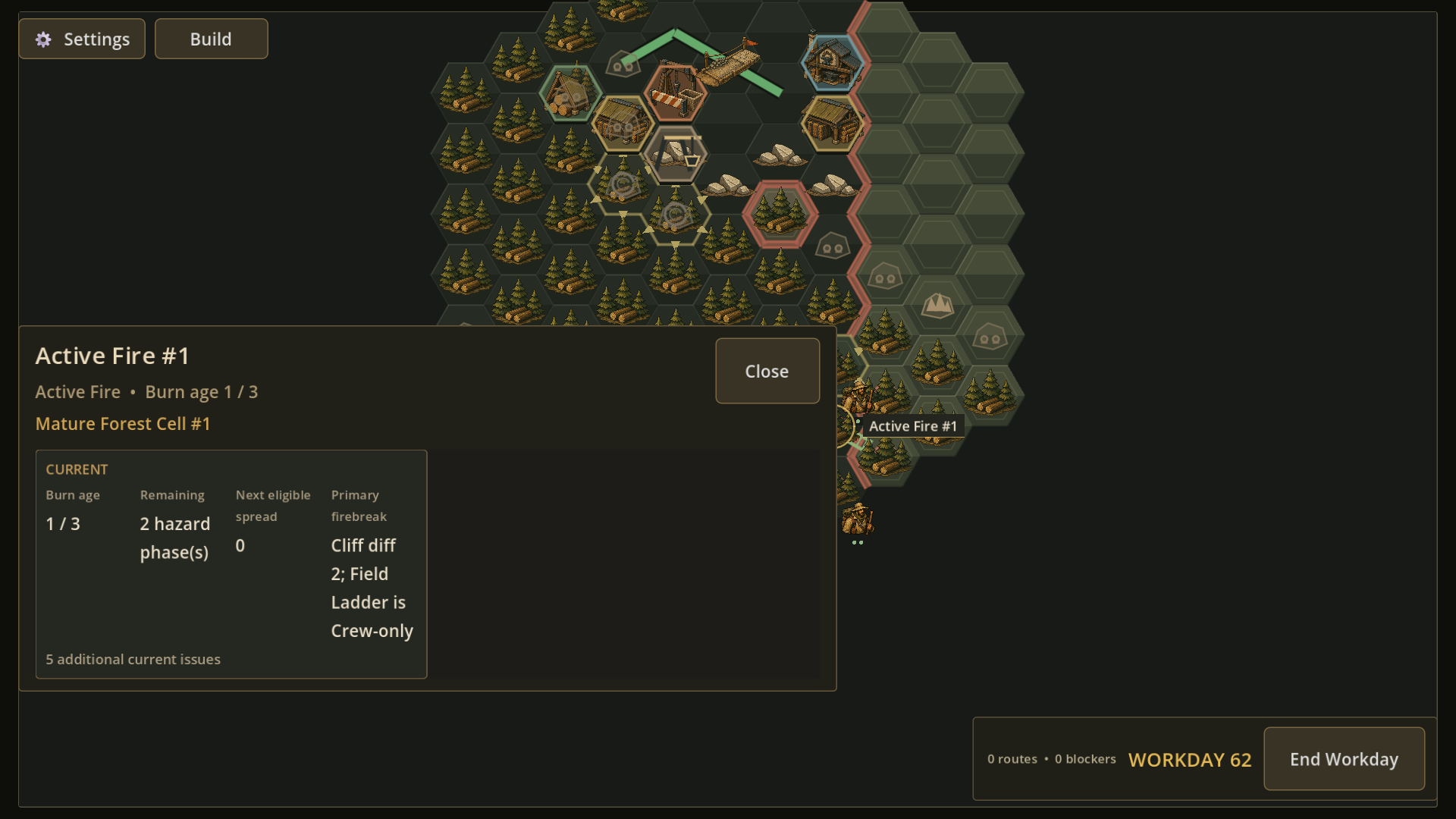
1 / 3, while the panel identifies a steep cliff as its firebreak and clarifies that the nearby Field Ladder is for Crew movement only.This is an earlier prototype, not current gameplay
In an August 1 development build of Frontier Logistics, we implemented a complete wildfire experiment inside the configured game. A Crew could prepare special equipment, ignite a Forest, watch Fire spread across the hex map, and deal with the burned ground afterward.
That system has since been removed. Active Fire, burn scars, recovery and the Fire Management Kit do not exist in the current gameplay model. This record is about what the playable experiment taught us and why we changed direction.
Why Fire looked promising
Frontier Logistics is a turn-based logistics 4X about directing small Crews, building regional infrastructure and deciding how finite world resources become a working economy. A Forest is both a Wood source and physical space that may compete with routes or construction.
At the time, most Forest change came from player-directed logging and slow regrowth. Fire seemed like a way to make the world produce its own fast, spatial pressure. A planned burn could open land, but it could also escape into neighboring Forest and leave a long-lived mark. Cliffs, water and already-clear ground could become meaningful boundaries rather than background terrain.
The interesting question was not simply whether we could draw flames. It was whether a spreading hazard would create better planning choices than direct harvesting and construction already did.
The playable sequence
The prototype began with preparation. A Workshop—a Facility that turns stored materials into equipment—could make one Fire Management Kit. The same physical Kit moved through regional Stock into a Crew's Pack and then occupied both hands. Only a Crew wearing it correctly could use the Fire actions.
The player then selected a neighboring Forest and chose Controlled Burn. Approval created an Active Fire 0 / 3 world object instead of immediately deleting the Forest or awarding Wood. At each Workday boundary, Fires that already existed tried to ignite eligible neighboring Forest, then advanced their own burn age. Newly ignited Cells waited until the next boundary, so the front moved by at most one ring per Workday instead of cascading through the whole region at once.
Terrain shaped the spread. A steep cliff edge stopped Fire even when a Field Ladder let a Crew cross it; the Ladder opened a route for people, not continuity for fuel. Clear ground, water and non-Forest Cells also acted as firebreaks. An occupied target could block one branch without cancelling other legal spread in the same boundary.
After its third hazard phase, a Fire removed the Forest and left Scorched ground without producing Wood. A scar received one natural recovery opportunity. If that failed, it could persist until a Crew reclaimed it with the same Kit or neighboring Mature Forest eventually recolonized it. Reclaim took more work than the Crew could always finish at once, so it could remain as an explicit command to continue on a later Workday.
What this image proves
The attached frame comes from that earlier configured-game prototype and is not a current gameplay screenshot. Active Fire #1 is selected after a spread step. Its panel shows burn age 1 / 3, two hazard phases remaining and a cliff difference of two as the primary firebreak. It also says that the visible Field Ladder is Crew-only: the Crew can cross, but the Fire cannot use it to reach the Forest on the other side.
This one frame does not prove the whole lifecycle. Neighboring frames from the same uninterrupted journey record the Kit attached to both hands, the initial Fire 0 / 3 target state, persistent Scorched ground, retained Reclaim work at 1 / 2, and a later Thin Forest result after recolonization. Together they establish the experiment's player-visible sequence; the selected image carries the central spatial decision.
The system worked, but the choice did not
The experiment produced a coherent chain: prepare equipment, choose where to ignite, predict the first spread boundary, protect occupied Cells, wait through the burn, then accept, reclaim or outlast the scar. It also made the design cost visible.
Once Forest became a finite resource, an autonomous wildfire could permanently erase scarce Wood and usable world space. That turned Fire into a monitoring obligation: the player had to keep watching for deletion rather than making a deliberate logistics choice. Removing random ignition and keeping only player-authored burns did not solve the problem. Controlled Burn then overlapped with Fell and site clearing, but required its own equipment recipe, attachment rule, world object, spread phase, scar state, recovery logic and reclamation command.
The system was mechanically substantial, yet it did not add a comparably strong decision. The prototype was useful because it made that mismatch concrete.
What changed for the current game
The current Forest model is finite and binary: a Cell either has Forest or it does not. Harvesting consumes that exact resource, and time alone does not regrow it. There is no Active Fire, spreading front, Scorched state, Fire Management Kit or recovery process in current gameplay.
For the player, this keeps the pressure attached to explicit choices. Which Forest should a Crew Fell? Which area should a Logging Camp consume? Which Wood should be reserved for construction, and which land should remain unavailable? Those decisions still have lasting consequences without a separate hazard demanding constant attention.
This earlier prototype remains valuable as a development record, but the attached image and every Fire rule described here belong to a retired experiment, not the current build. It does not imply that Fire is planned to return; any future hazard would need a new player-facing reason rather than inheriting this system by default.