Giving Floodwater Somewhere Else to Go
Work recorded: August 1, 2026
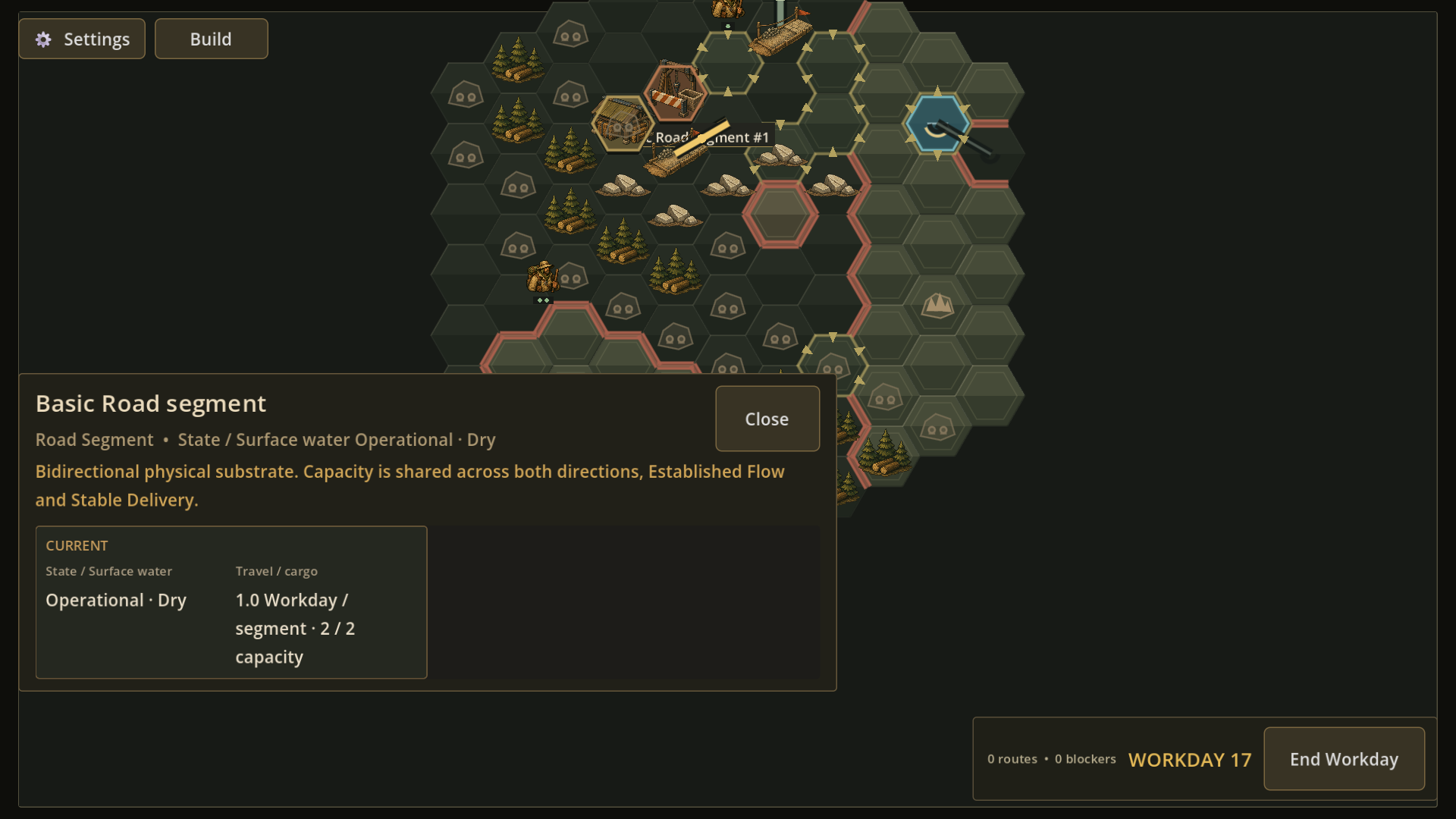
A road can still exist and fail you
In Frontier Logistics, a Workday is one turn in which travel, work, production, and logistics advance. Surface Water is part of the world rather than a decorative river tile: rain enters the map, low ground stores it, and only the water above a basin's spill level moves downstream.
That distinction matters when infrastructure crosses low ground. A Basic Road normally helps Crew travel and can carry two units of cargo through a segment during a Workday. In this earlier build, one 12-unit Rain Event filled a nearby basin and spilled across a Road. The Road was not destroyed. Instead, Shallow Water removed its movement benefit and reduced its cargo capacity from 2 to 1. Deeper water could stop the segment entirely.
The old problem was not simply that a blue hazard appeared. The player needed a way to understand where the water came from and spend real construction capacity on changing its route.
Read the basin, then draw an outlet
The player first inspects the flooded cells, the natural Channel Bed, and the Road that has become a bottleneck. A Drainage Draft is then drawn as an ordered line from an inlet toward a valid lower outlet. It cannot end in a sealed depression or climb uphill without a pump; the proposed path has to give the water somewhere physically valid to go.
Once approved, each segment becomes a Project. In this recorded version, every segment required one Stone and two units of work from the same Roadworks team that also built and repaired Roads. Drainage therefore competed with expanding the transport network: protecting an existing route meant postponing some other piece of infrastructure.
After the channel was commissioned, the same 12-unit Rain Event was run again. Without drainage, the watershed retained 7 units and discharged 5, leaving the Road shallow and limited to 1 of 2 cargo capacity. With the channel, it retained 5 and discharged 7. The threatened Road stayed Dry and kept its full 2-of-2 capacity. The channel did not delete water; it changed which path could carry it out.
What the player is choosing
This turns flooding into a spatial logistics decision. The player can accept a slower route, build a new Road elsewhere, or spend Stone and Roadworks time on a channel. A channel that protects one Road also needs a real outlet, so its downstream destination and possible backwater matter. The question is not just how to remove a warning icon, but which parts of the network are important enough to reshape the landscape around them.
The image records the earlier build after drainage was commissioned and the matched rain had resolved. Select the highlighted Basic Road and read the lower panel: its surface state is Dry, and its cargo capacity is back at 2 / 2. The surrounding map still shows the basin, water path, and constructed route that produced that result. Hydrology and constructed drainage remain in the current design, while the interface, presentation, and balance continue to evolve.