When the Workshop Stopped Looking Like a House
Work recorded: August 12, 2026
A Facility has to read before its details do
Frontier Logistics is viewed across a strategy map, where a Facility has to work as a building-scale world object before its small parts can be read. The Workshop in this study is a proposed heavy-fabrication Facility. The question here is visual rather than mechanical: when the camera is pulled back, can a player tell that this place is organized around making and handling heavy things?
That viewing distance changes the order in which the design has to communicate. Small tools, seams, and controls disappear first. The outer mass, the division between open and enclosed space, and one dominant shape have to establish the idea. Closer views can then explain what the silhouette only suggested.
Three reasonable corrections, three different misses
The first Workshop study made its process easy to follow by leaving the equipment exposed. It showed a sequence of machines, but in the landscape it read as equipment placed on a platform rather than a substantial Facility.
The next correction wrapped the same machinery in walls and a broad roof. That made it more building-like, but the enclosure became a generic, cumbersome house and hid the useful process anatomy underneath. A later study rebuilt the upper structure as one more coherent fabrication hall with a press visible through a work bay. It was a better building, yet the complete shell and paired roof still arrived before the Workshop itself.
Each attempt solved the previous complaint literally. Together they revealed the actual problem: neither exposed machinery nor a generic envelope was enough. The machinery had to determine the architecture.
Reorganizing the Cell around the press
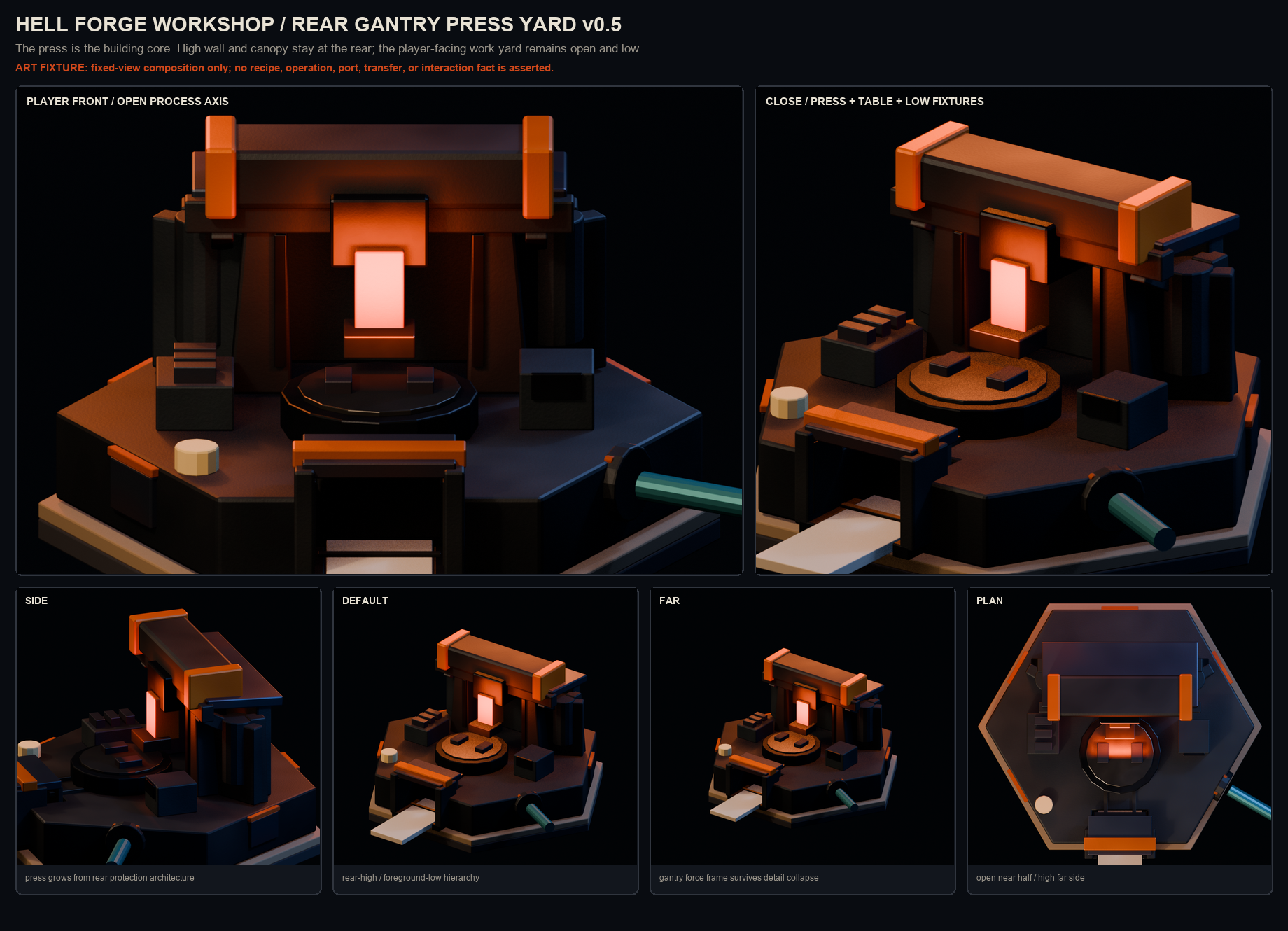
The completed v0.5 study reversed the hierarchy. A large gantry press moved to the player-distant side and became the highest, widest part of the composition. Only the rear received a high protection wall and a shallow weather canopy. The player-facing half stayed open and low, with a broad work surface and small support fixtures below the press crosshead.
From the demonstrated front view, the eye can travel from the open front edge across the low yard to the press ram without a facade blocking the sequence. At the default and far views, the small fixtures collapse, but the press frame still survives as one readable sign. This is the useful result of the study: a Facility can feel substantial without hiding the process that gives it a purpose.
The revision also exposed a trade-off. The spatial organization became clearer, but the clean rectangular press and rotary table were generic enough that the intended Hell Forge identity weakened. Solving the silhouette did not finish the visual language; it made the next question more precise.
How to read the image
The review board collects the same Art study from several distances. In the large player-front frame, look for the low open yard beneath the press crosshead. The close frame shows how the work surface and support fixtures sit below that dominant machine. The default and far frames test whether the press remains identifiable after detail falls away, while the plan view makes the open-front, high-rear organization explicit.
This is a Blender concept and Art study. It is not current gameplay, it has not been integrated into the game, and it is not a final production asset. The Road-like opening, side pipe, press, table, and other fixtures establish composition only; they do not define ports, recipes, Crew access, machine operation, or production flow. A newer exploration is still examining how to restore a stronger Hell Forge identity without losing the spatial clarity demonstrated here.