When a Road Wasn't Enough
Work recorded: July 31, 2026
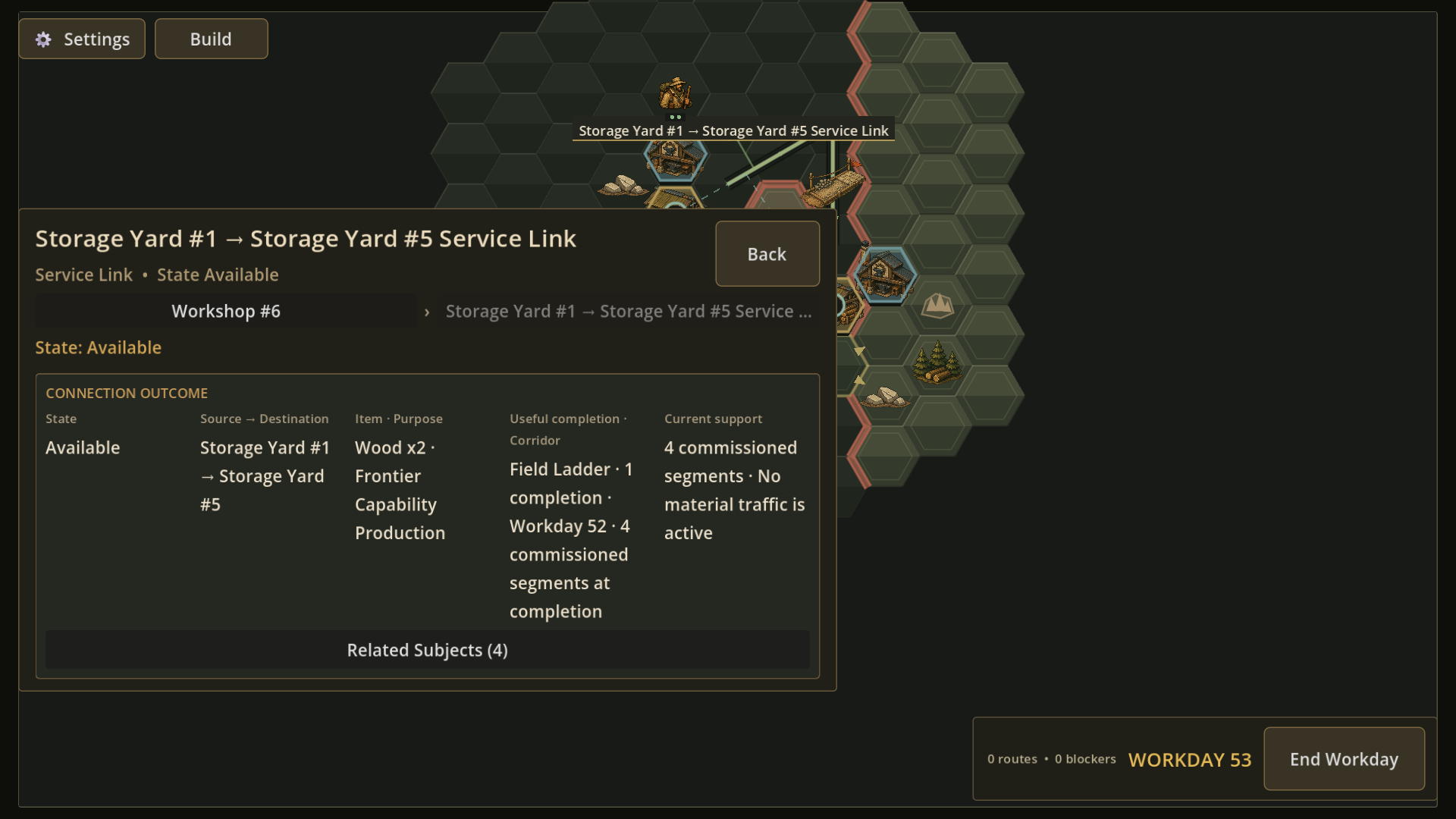
Earlier development record · Not current gameplay
In an earlier Frontier Logistics development build, we tested a strict definition of a useful connection: building a Road between two regions was not enough. Sending materials along it was not enough either. The relationship appeared only after the remote destination used that supply to finish a physical result.
That build recorded the result as a persistent Service Link. Service Links and the related Frontier Extension record are no longer part of current gameplay. This article documents the playable experiment, the useful rule underneath it, and why we later removed the extra record.
From a corridor to a completed result
Frontier Logistics is a turn-based logistics 4X about turning distant parts of a hostile world into one working economy. In this older prototype, a Cluster was a regional group of Facilities sharing Stock around a Storage Yard. A Workshop was the Facility that converted stored materials into durable equipment.
The player placed an Order for a Field Ladder at a remote Workshop. A Field Ladder was physical gear that a Crew could later carry and deploy on a steep cliff Edge to open a traversable route.
At first, the Workshop did not have the Wood required by the Order. The player commissioned a Road corridor from a supplied Cluster to the remote one. A material Flow then began moving Wood through that corridor.
The prototype deliberately withheld the Service Link through each intermediate step:
- The Order alone did not count.
- The commissioned Road did not count.
- A responding Wood Flow did not count.
- Work in progress at the Workshop did not count.
Only when the exact Wood contribution entered production and the Workshop completed one stable Field Ladder did the old build create a directed Service Link from the supplying Cluster to the destination Cluster.
The relationship outlived the delivery
The material delivery was finite. After the Order was satisfied, the Flow stopped and there was no active traffic on the corridor. The Service Link nevertheless remained Available, because the route had already demonstrated one useful production result and its commissioned Road segments still supported the connection.
The same Ladder did not remain an abstract score. It moved from Workshop output into Crew custody, then the Crew deployed it at a cliff Edge. In that prototype, the completed chain could also appear as a Frontier Extension: supplied materials had become equipment that changed where a Crew could travel.
This created a meaningful player trade-off. Road capacity and Wood were not rewarded merely for existing. The player had to decide which remote Order deserved those materials and whether its concrete result justified the corridor.
What to inspect in the image
The attached image is from that earlier configured-game prototype, not the current interface. The selected panel shows a Service Link from Storage Yard #1 to Storage Yard #5 in the Available state. It records Wood ×2, one completed Field Ladder, and four commissioned Road segments. It also states that no material traffic is active.
That combination is the point of the frame: the temporary delivery has ended, but the old build still remembers that this corridor completed a useful remote result. Neighboring states from the same configured-game journey establish the blocked Order, Workshop work in progress, Ladder custody and later cliff deployment; this image carries the persistent-relationship part of the story.
Why we removed the extra record
The experiment established a rule we still value: infrastructure is not useful merely because it was constructed. A real logistics chain should lead to production, custody, delivery, access or another concrete world result.
But the persistent Service Link duplicated facts that already existed elsewhere. The Workshop output proved production. The Field Ladder's custody proved where the equipment was. The Flow and Road proved how materials travelled. The deployed Ladder and changed traversal proved the world consequence. A separate relationship identity, availability state, history and extension record made the player read the same truth twice.
Current gameplay therefore has no Service Link or Frontier Extension entity. It keeps the underlying material chain and reads usefulness from the actual owners of each fact: production, items, custody, Flows, commissioned routes and deployed world equipment.
For the player, the central decision remains. A Road is potential; committing scarce materials to a remote result is what makes it matter. What changed is that the game no longer needs a parallel label to say so. Exact presentation and balance remain in development, and the attached UI belongs only to the retired prototype.